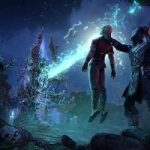

EVE Frontier, in my mind, after talking with developers and sitting in on keynotes during EVE Fanfest, feels a bit like EVE 2.0. For a company that desires EVE to outlive us all (the EVE Forever! Chants at Fanfest 2025 are still ringing in my ears as I type this), Frontier feels like it truly could be the key to doing so – if the development team can pull it off.
EVE Frontier is dubbed by the devs as a massively moddable multiplayer online spaceship survival horror roleplaying game (or MMOSSHRPG for short). Its setting is the distant future, but almost an ancient future world. Where EVE Online is futuristic, cyberpunk to the extreme, EVE Frontier’s world is more akin to Conan the Barbarian – but in space.
Players will inhabit their own spaceship after being awakened by a mysterious entity in a universe where it’s clear that an ancient civilization has been extinct for thousands upon thousands of years, with no indication of how or why.
“More things were forgotten in this world than we could ever hope to be,” EVE Frontier Creative Director Pavel “CCP Maximum Cats” Savchuck explained in an interview at Fanfest earlier this month. Pavel describes a world where so many post-apocalyptic cycles of destruction have happened and it’s been countless years since humanity’s extinction that the players who inhabit Frontier’s universe are operating on more of a “primal” level. Note that they aren’t primitive by any sense, but so much time has passed and the secrets of this long-gone civilization are lost, and that players are experiencing the world around them on almost mythological scales.
“If you’re familiar with the famous Arthur C. Clarke quote that ‘Any sufficiently advanced technology is indistinguishable from magic,’ they are living in a world of magic.”
This primal, mythological feeling is soaked into every fiber of EVE Frontier, especially with its terminology. Players aren’t capsuleers like in EVE Online (if, for no other reason, they aren’t housed in a capsule), instead they are Riders, riding their mythological steed (spaceship) through the Frontier. Corporations (or guilds) in Frontier are Tribes, and so on. The technology around players are described on almost mythological terms, such as the giant space harvesters that gather resources from moons being referred to as “Moon Eaters,” and AI are simply Demons.
I’ll say too, I found this all pretty compelling. It’s an interesting way to look at the future – a society that might not have been blasted back to the stone age technologically, considering that Riders and those who inhabit the Frontier are still able to utilize this long-ancient technology (or Magic as they would see it), but civilization itself might as well be back in the stone age. We’re not a cog in the gears of industry like in EVE Online; rather, we’re hunter-gatherers, building the Frontier and civilization as we know it with each passing moment.
Despite the mythological underpinnings, EVE Frontier is a game rooted in real-world science. Bases are established in Lagrange points in orbit around celestial bodies, while the very nature of space time is being torn asunder in sort of a celestial “meat grinder” as Pavel put it during a press pre-brief at the event, thanks to the multiple black holes at the center of the galaxy.
Piloting your ship with skill matters even more so here than it does in EVE Online. Occlusion and line of sight also matters – allowing players to hide within the din of the cosmos, hiding from potential predators or stalking their prey. Heat signatures can give away your position in combat, and bullets, unless they hit something, simply go on moving forever throughout the vast reaches of Frontier’s star cluster.
You’re limited by your resources, your knowledge of the area, energy, and so much more. Again, as Saemundur “CCP Goodfella” Hermannsson tells me, Frontier is all about survival in the end.
“I will say, at its core, EVE Frontier is all about survival. This is survival of yourself in a super hostile universe. You don’t know what’s around you. You’re constrained by resources, you’re constrained by energy, constrained by inventory, and you’re thrown into this massive universe where you need to build out your place in space in order to survive.”
“I can extend this idea of survival further where I would say that it’s survival, starting from an individual to survival of a civilization,” Pavel adds.
Building That Civilization
EVE Frontier was referred to as a “civilization engine” a few times during the Fanfest weekend, and I found that incredibly fascinating, especially since Frontier at first glance seems like a lonely experience. Every civilization needs people, and those people need to form communities in order to thrive. So how does this happen, and how does it materialize in a game that isn’t technically out yet?
Speaking with community developer Ben “CCP Jotunn” Sisson and product manager Scott “CCP Overload” McCabe at the show, Founder’s Access has been instrumental in this process.
“We just try to be open and honest about [development] as much as possible, and let people come in and play it,” Scott McCabe tells me in our interview. “Now if we go and build a game in isolation by ourselves and inevitably become an echo chamber, then we’re going to turn up in a couple of years and be like, ‘Hey check out what we made.’ And everyone will be like, ‘That’s not what we want.’ So the earlier that we can let people get hands-on and play things and be a part of it, we call it a kind of co-development, but it’s not just a buzzword. We listen to the Founders a lot.”
“Even deeper than that, it’s not just about being honest about where the game is, it’s being honest about where we are in development,” Sisson adds.
While at Fanfest, I was able to play an early build of Frontier, and it was definitely early. The basics are there, from the base building to basic industry and resource extraction functions. Honestly, it reminded me a ton of EVE Online from the current state of the UX and UI to how Frontier handles. However, even in its early days, it’s easy to see that it’s different enough to warrant a whole new game and not simply dub this EVE Online 2.
The Founders’ access currently going on provides that valuable insight the development team needs to further refine the mechanics of Frontier, as well as gather feedback from free weekends, which the Frontier team runs rather regularly. Despite it being early days, the community is there, and they are already doing some incredible things.
Despite starting alone in the frontier of space, EVE Frontier Riders will eventually come up against other players. Civilizations, in this sense, happens organically, starting with that social interaction, oftentimes beginning with violence.
“First and foremost, we’re building on our lessons from EVE Online and elsewhere,” Pavel explains.
EVE Online’s player empires, such as PanFam and Goonswarm, are, in a sense, small civilizations that have popped up organically throughout the 20+ years the MMO has operated. So it’s not a bad test case to pull data from, especially as those empires continue to break world records and spawn history books all their own.
The team has already seen pockets of civilization crop up over the phases of testing since Founders’ access went live last year. One civilization popped up accidentally, according to CCP Maximum Cats, thanks to a test where a key resource didn’t spawn like it should have.
“We had this episode in one of the phases where all the players could choose a constellation where they respawn, and that was the limit. They were isolated from the rest of the universe. You had to craft your way up towards a jump drive, and then you could leave the constellation, and then eventually meet other groups of players. Unfortunately – or fortunately – in hindsight, a few of these constellations were generated in a way where a key resource was missing. They could not build their way out.
“So they ended up in this kind of freezing island, isolated with each other. And those guys worked out this civilization, a society, where they bonded by this thing that they were in. And that civilization, even after they convinced another player that broke out of their star cluster and made it all the way to them with this resource, they were promising to help. And in a classic EVE Online way, once they got in there, they put this resource up on the local market for exorbitant prices. Even after they got saved and they built the stargate to get out of there, it was a massive celebration for this civilization, that group persisted. They are a society. So that particular region is now the civilized region of Frontier, where there is the most security, because there is the most established civilization.”
Massively Moddable
One of the major fundamental aspects of Frontier is this idea that the universe is inherently moddable. Structures can be modded to suit your needs, and whole experiences can be created within the framework of EVE Frontier that are entirely controlled by players.
An example of this during our gameplay demo was a stargate built by a player that required you to deposit some EVE, EVE Frontier’s version of EVE Online’s PLEX, in order to access the gate, sort of like a toll booth. This was added by the players themselves using the MMO’s Smart Assemblies feature. This is also where some of the controversy surrounding EVE Frontier centers because that feature is powered by blockchain technology.
“We talk a lot about how EVE Online is not a SQL game,” Sisson says when asked about how the Frontier team plans to overcome the stigma surrounding blockchain technology. “It is a SQL game, it was built on a SQL server, right? No one promotes it like it’s a SQL game. The blockchain tech is just something we’re using in the backend to support a lot of the cool things we want to do. It supports the moddability of it, it supports the customizability of the configuration for different modules. It is a neat tech, a cool tech that we are allowed to do cool things with. But it’s just the back-end stuff.”
McCabe recognizes that there is a massive stigma around blockchain and the grift that many developers and Web3 companies have participated in over the years since it has gained mainstream attention. But for the Frontier team, it’s about unlocking the limitless potential for player creativity and the ability for those players to impact the Frontier universe around them in a real way.
“It’s not an unjustifiable opinion for people to form, like these aren’t coming out of nowhere, right?” McCabe says. He continued, “I don’t blame people for this. It’s totally understandable. There has been a lot of crap out there, which is a real shame because there is so much that the tech does actually unlock. Like when we did the demos yesterday, we’re talking about the gates and the logic being enshrined in such a way that you make laws for your little cohort, you build your own little group in space, and you set up a border where you’re like, ‘Hey this is our territory, we have our gate networks and we’re going to issue a visa. And as long as you follow our laws, you can use all of our gates and things like that.’”
McCabe likens this scenario to traveling abroad, where the laws of the land you’re traveling within are clearly defined in our world. We know what we can and cannot do, and the consequences of breaking that law. He then tells me to imagine a world where those laws aren’t clearly defined, where they can change at any moment, and I simply have to trust those in charge that I’m not breaking the law – new or otherwise – at any given moment. That just would not end well. Blockchain is one way that players can rest assured that everything they need to know about an area or what they are getting into can be clearly defined, because it’s written for all the public to see, thanks to how the tech works.
Saemi states that the team didn’t set out to create a blockchain game from the jump, but rather realized early on that blockchain was useful to realizing the vision they had for Frontier: creating a virtual world more meaningful than real life. The way to do that is through the third-party development that blockchain can enable, like the aforementioned stargates players can program to allow only certain players to pass through if they pay the toll or have a predefined visa – or whatever. The possibilities are endless there.
“I firmly believe that one of the reasons for the longevity of EVE Online is third-party development,” Saemi tells me in our interview. “If it weren’t for third-party development, EVE wouldn’t have flourished as it has. Third-party development in EVE has emerged from this super-thin read API layer, and some parts of what the players show to other players about who they are and what they’ve done, etc. This amazing thing that has kept EVE going for two decades has emerged from that. So our premise is, ‘Okay, can we push that further with blockchain?’ You get a read/write API out of the box, being able to write because it’s authoritative. I own it. I can put rules on it.”
This does, in a way, feel a bit like the wild west, where giving that much authority to players could feel challenging to grapple with. But, in a way, the blockchain is where the immutable laws of the universe are written, on a database for all to see, instead of the feeling of CCP Games tweaking every little tiny thing, from the asteroids in some far-flung corner of space to changing how the rules work for everyone.
The obvious question, then, is whether or not this could be built without using the technology. And while it’s possible, in the end, according to CCP Games CEO Hilmar Veigar Petursson, you end up with something that looks remarkably like a blockchain.
“It will be possible, you just very quickly end up with a lot of things which are very much like a blockchain. Because as soon as you allow people to add new features to the game, you need opcode copy, because otherwise people just end up writing bad code, and they innovate a Sybil attack – it’s like a DOS attack on the economy, by just writing bad software. But by using the GaaS economy of a blockchain, you incentivize people to write efficient code. So you need a system like that. Then, if you’re distributing it, you need some mechanism to validate that people are not cheating on their individual node; you either need consensus or you need zero-knowledge proof-based approaches, and most blockchains are adopting those. It’s a little early, it’s a few years away, but eventually it will. […] You can pick it apart any way; it just ends up being kind of blockchain-ish.”
Looking To The Horizon
EVE Frontier is still very much in its infancy, but its active development with the players has borne fruit in ways the team couldn’t begin to imagine when they started this journey. From players building out the very stargate network systems needed to more efficiently connect the tens of thousands of solar systems in the Frontier star cluster, to players using the smart assemblies features of Frontier to build their own crazy creations, including an in-Frontier version of a game similar to Pokemon Go to someone creating a recreation of the moisturize me character from Doctor Who that gives fuel in exchange for water, Frontier feels somewhat limitless in what players can create.
And that limitless creativity is one of the reasons why having a moddable universe like Frontier feels so compelling to me. Player creativity has always felt like it’s been at the heart of EVE Online, and more so here in even the early stages of EVE Frontier. I’m curious to see how things go, especially as development continues to hurtle forward towards an eventual full release down the road.
I’m also incredibly curious about the backstory of this universe, how it relates to the broader New Eden star cluster from EVE Online, and how player-created narratives will help to uncover more of the history of the doomed race of humans whose ruins we’re exploring.
Like I said at the start, this feels like EVE 2.0 – not necessarily EVE Online 2, which I think are wholly distinct ideas. This isn’t a sequel to EVE, rather it’s EVE created using technology that didn’t exist back in the late 90s when the MMO started development, but using ideas that have clearly lived in the heads of CCP Games’ developers all these years. While the player escapades that drive the story and drama of EVE Online feel limitless at times, the MMO itself is still very much constrained by its technology and legacy. Frontier doesn’t have that same feeling when I think long and hard about what it can represent. A true universe that is endlessly interactable by the players who inhabit it, who can shape the very fabric of their corners of the universe and define how they live out their days, surviving in the harsh world of Frontier – that sounds compelling in ways that other survival games fall short.
It’s clear that CCP Games is taking its time with EVE Frontier to ensure it’s the best possible massively moddable multiplayer online spaceship survival horror role-playing game it can be. And, much like the Riders sailing the stars on their own mythical beasts, I’m along for the ride.
Full disclosure: Travel and accommodation to EVE Fanfest was provided by CCP Games.