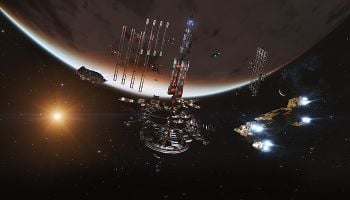

The MMORPG genre is often shaped by rigid structures such as quests, raids and instanced battlegrounds. Nevertheless, behind this “mainstream” offering, a few titles priding their player agency are getting back in the spotlight. When we speak of this concept, we obviously think about EVE Online, a pioneer in the field; Elite Dangerous, whose latest update ‘Trailblazers’ is now available; but also about Stars Reach, an in-development project whose Kickstarter has just come to an end. These examples, both new and established, are proof that innovation is still very much a possible for MMORPGs, a genre still dominated by the World of Warcraft recipe.
Themepark Vs. Sandbox
Most MMORPGs follow a themepark model, where developers create contents that you progress through in a linear or semi-linear way. This has its strengths, but also restrict the impact you may have on the world. When a raid is cleared, or a questline completed, these are discovered for good… and ready for a next cycle of adventurers to enjoy the same experience.
Sandbox MMORPGs, on the other hand, turn this dynamic on its head. Rather than guiding you along a developer-created narrative, they give you the means to create your own goals. Elite Dangerous’ recent Trailblazers update illustrates this philosophy with a new feature that let you claim uncharted star systems and set up persistent colonies in the universe. This Colonization system has real and lasting impacts, such as the fluctuation of economies and territorial expansion changing the experience for everyone.
In the same way, EVE Online is praised for its player-made economy and politics. Alliances fight for control of star systems, corporations leverage their way into the market, and espionage forays can lead to catastrophic financial losses—all without any developer input. This level of emergent storytelling, where your actions drive the narrative, creates universes that evolve organically.
The field of possibility
The actual engines of this player agency are the systems that operate these Sandbox MMORPGs. Typically, this Colonization system in Elite Dangerous opens up a huge range of possibilities. You can develop a space trading port, establish a base of operations at the very edge of the galaxy, set up an outpost for your faction etc… These examples, which players have seized upon, allow each and every one of us to have a significant impact on the MMORPG universe as a whole.
The upcoming Stars Reach seeks to take these ideas even further. Featuring a sandbox-style universe with planets to colonize, governments to form and trade agreements to negotiate (or impose), the MMORPG positions itself as a next step in player-driven MMORPG design. If successful, it will stand alongside EVE Online and Elite Dangerous as a benchmark for emergent gameplay.
A few drawbacks
While these MMORPGs provide almost limitless freedom, they face some challenges as well. Player-driven economies can be erratic, and malicious actors can wreak havoc on markets. The same goes for player-managed constructions, as Raph Koster explained about the Flooding of Gaiamar in Stars Reach pre-alpha. Fortunately, Playable World seems to have that in mind, as Raph points out in his latest AMA with the MMORPG subreddit:
First: no direct harm on other players, that might seem obvious, but I have seen many people miss that.
Second: no direct harm on other people’s property (their homestead, etc).
Third: no harm from anything indirect we can actually detect. We can detect if someone opens a lava pit near you. We cannot detect if someone redirected a river somewhere on the other side of the planet, and through a butterfly cascade of events, that means that your crops on the other side of the planet get less water. Yes, people will use this for griefing, but it’s also just gameplay. You are multiple people participating in a dynamic system, and stuff like this will also happen by accident. (The Gaiamar story you recite was mostly an accident, not intentional griefing).
Fourth: communities with the power to grant or revoke permissions to do things. This isn’t just ostracization. We want governments to be able to do things like block entry to non citizens, or deny terraforming powers by area or by planet. You could need to ask for a license to be able to do what happened in Gaiamar. (In fact, you WOULD have needed that license, because it happened inside the town boundary and by default private citizens wouldn’t have been able to affect stuff within the town but not within their homestead).
(From r/MMORPG)
Also, content is not necessarily organized, which can discourage newcomers. Some players may feel lost in the absence of guided quests or clear progression paths. Albion Online has cleverly solved this with its easily understandable progression wheel, which is also related to the crafting and equipment mastery systems.
The Future of MMORPGs?
Still, as intimidating as these challenges may sound, the longevity of some sandbox MMORPGs indicates that there is an audience seeking for these deeper experiences. The long-term success of Ultima Online over nearly 28 years, the steady growth of Albion Online, and the recent buzz around Stars Reach all suggest that there’s a market out there for player-driven MMORPGs.
This also opens up wider questions over the future of the genre. With many MMORPGs now hinging on seasonal content and battle passes, player-driven worlds could serve as an alternative format—one in which the trajectory of the game doesn’t change with patches, but with the choices that players make. Not all MMORPGs will use this model, but the very existence of it keeps a genre that threatens to homogenize diverse.