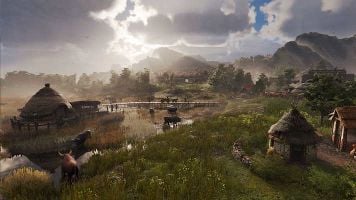

After 25 years, Anno, Ubisoft’s builder that tasks players with transforming an empty island into a thriving metropolis, is embracing Ancient Rome. Anno 117: Pax Romana tasks players with being a Roman Governor creating provinces and extending the glory of the Roman Empire, balancing their people’s needs with the Emperor’s demands.
Ancient Rome has been one of the most requested settings for Anno, and with this new time period and history comes a bevy of new features. Pax Romana brings back military land combat but also introduces modular naval combat. In addition to combat, the game also introduces a bevy of new elements to the series, some of which build off of key quality of life updates and post-launch season additions to Anno 1800, the best-selling title in the franchise.
Additionally, Anno 117: Pax Romana also introduces elements not in the franchise before like Discovery trees, faith decided by selecting Patron deities, modular building development (for both natural resources and other building elements), aqueducts, deeper choice-driven storytelling, and enhanced graphics for exploring your provinces with even more detail.
But it’s not just what players can do in Anno 117 when it comes to building that is brand new to the game. Anno 117: Pax Romana’s biggest change is that it adds an active pause button. Yes, you’ve been able to pause Anno for some time; however, when paused, players were not able to build, blueprint, or move buildings. When the community began talking about adding a pause button, Ubisoft Mainz’s response in the Anno subreddit was:
“The way the game, or more specifically the engine is set up, everything is calculating in “ticks”, e.g. the game needs to be running, be active. It’s a real-time strategy game after all. An active pause, however, would allow players to do actions while all of the game’s processes are paused completely. That’s simply not something our engine for 1800 supported. We did add a slow-mode option, however, that should provide a bit more breathing room if the game enters a stressful period.
We’re by no means ruling out “active pause” for any future projects, when we have time to update our engine to support such a feature (plus, solve open questions like: what’s the situation for multiplayer?). After all: We’re always happy to see more players enjoy our games!.”
The choice to add it to Pax Romana feels more like a push to bring in new players, especially as the game plans to launch on consoles day one. During my first playthrough, I didn’t touch it. Out of habit, I just let the game run. The real-time element of Anno as a series pushes the player to understand their islands, and as the end game starts and the number of islands you’re managing grows, the inability to pause and build is a stressful but exciting element of the game. But, after talking about the pause button with my peers, when I played during the digital preview, I tried it.
My impulse as a dedicated Anno player was frustration. A pause button immediately feels like it goes against what distinguishes the series in the builder genre. That said, in practice, a pause button adds an entirely new element of challenge. Because population balance is key to staying positive and not going bankrupt, adjusting in real time is fairly essential. However, if you pause, build, and then press play, it’s extremely easy for everything to fall out of balance and put you deep in the red.
So while the addition of a pause button allows you the chance to adjust your islands and removes some stress, what happens when you press play can vary. This allows the pause button to debut with a difficulty balance. While I’m not entirely sold on the addition, I’m intrigued to see how it impacts a save file about 100 hours in.
Anno 117: Pax Romana also adds new building elements that thin out the line between beauty builders and optimization. The first way this latest addition to the series does this is by adding building buffs to shoe-making shops, bakeries, hat makers, and more. The buffs can increase the money each residence produces and happiness. As a beauty builder who sequesters all my production ugliness into optimized areas far away from residential areas, I found it extremely easy to go negative by not taking advantage of the buffs.
While building buffs from the beginning of the game are new, the tourism addition to Anno 1800 brought building buffs of sorts with restaurants and pastry shops with the Tourist Season DLC. The building buffs in Anno 117 feel like a natural progression of what Ubisoft Mainz has introduced as new additions to its last game and the free quality of life updates that solidified that game as a certified stellar builder that only got better the longer it was supported.
After I rebuilt the residential areas and added production-focused buildings, the production of denari ramped up quickly. But, so did the fire risk. While fire, riots, and disease have been consistent in Anno, Anno 117 has an increased focus on the fire element. Each building has a fire risk, and the closer you place them to each other, the higher the chances of a fire breaking out are inescapable.
While I was always worried about fires in Anno 1800, it wasn’t until the late game, with the last round of buildings, that I was paranoid about not having enough fire stations. Here, a section of residential buildings that I proudly placed myself in to get the most denari out of all burned. Adjusting your building to take into account fire stations winds up pointing out two crucial factors.
The first is that building at an angle doesn’t always connect the buildings that you’re running them to. Often, instead, they’ll be half a grid square off, causing it not to be connected to a storage house or burn down because the fire station can’t reach it. Checking your roads over when you choose to place them at an angle is essential.
The second element that affects Fire Stations is the addition of 2×1 buildings that help each of the facilities. A water well allows Fire Stations in Anno 117: Pax Romana to handle fires more easily, and also impacts the chance of them starting. Following that, watchtowers perform the same function for Police Stations, and then latrines affect public health and the Hospital buildings.
By adding in this element, you can better optimize your buildings, but you know what is more important? These small 2×1 buildings help facilitate doing more with small gaps in building with something that has purpose instead of just adding an ornament that is there to just look pretty. Don’t get me wrong, I love ornaments, especially as additions that give your island more personality. However, the challenge of making an island gorgeous while taking into account a latrine or even a production building is a task that is more exciting than just building an island dedicated to sewing machines or an ornate fairground.
The ability to use every single individual cell effectively is the real power behind the changes to how building works. Being able to connect buildings at an angle and the development choice to allow fields to be built by half grid squares, as well as allow you to optimize every bit of your island in ways you couldn’t before.
Additionally, going angle-happy with your building can also paint you into a corner as you build. This is especially true when you build farm land, as fields can’t be adjusted once you’ve started to build them at an angle. Once you’ve decided you’re ultimately stuck there, although the satisfaction of a crisp and not jagged line created along rivers really delivers the perfect serotonin-building blast.
Anno 117: Pax Romana is an exciting challenge for every beauty builder. At the same time, these changes to Anno give this title its own unique flavor that ensures that players who are depely invested in the series don’t feel like they’re repeating the same actions, engaging with systems the same way, and ultimately creates a compelling experience beyond just the change of setting.
Pax Romana pushes your expectations on how to build, especially if you have been using the min-max Excel sheet guides in Anno 1800. What worked well in the previous games doesn’t translate completely to this one. Instead, you have to get out of your comfort zone and find a way to blend beauty and function. Adding lavender fields to your residential areas impacts happiness, forcing you to understand how to build a field in the middle of houses.
While fertility has been important when it comes to island selection, there is a renewed importance on it with Anno 117’s approach to building. Introduced in the Land of Lions DLC with Enbesa’s clay and paper production supply chains in 1800, the rivers in Pax Romana are modular in nature. You can use any river slot to produce any river-centric product. For now, that includes flour and clay. While this isn’t specifically tied to fertility, the modular approach to resources extends to mountain resource deposits.
Where deposits were once pre-selected based on the island, mines can be placed on mountain slots, reflecting the resource your island’s fertility allows, versus being tied to just one. If you have the fertility for the resource, all you have to do is place the mine in the slot and you’re done. This element does allow for easy resource production initially, as you begin to use those same slots for aqueducts, you have to invest time in planning and managing what you produce. At the same time, the aqueducts are expensive to produce when it comes to concrete.
Where 1800 caused you to rethink how you build the first version of your city when it comes to laying railroad lines and depots, Pax Romana’s aqueduct also pushes you to think about how you build your cities. The aqueducts help deliver water to residents when capped with fountains, as well as reducing the overall fire risk in the areas they flow through. Unlike with railroads, however, you don’t have to always move your existing buildings. The aqueduct pathways can go over certain buildings. However, the fountains represent interesting elements to the placement and organization of the water system.
In some ways, having ample choices can cause quite a bit of decision paralysis, but if you don’t plan it out, you can easily wind up reaping the consequences of poor choices and not progressing due to poor resource management.
The final aspect to building up your island in Pax Romana is the Governor’s Villa. Well, technically, it’s the very second thing you build after your harbor, but you get what I mean. In order to build up your island, you must place the Governor’s Villa. Similar to the Palace and Hacienda that were introduced into Anno 1800 with the “Seat of Power” DLC.
Another expansion of a great concept launched first in the previous title, the Governor’s Villa is modular in nature, with each new module allowing you to house specialists (similar to Great Persons or Town Hall people in 1800) that will impact your island. That said, you can’t just place this Villa in near the shores of your island. This is due to the return of land combat. To take over other islands by force, you have to take over their Governor’s Villa. Building defenses around your shoreline, and making sure you’re Villa is in the Island’s interior, is important, at least according to the tutorial.
While I’m sure most readers are itching to learn about how Ubisoft Mainz has brought land combat into Pax Romana, I don’t really have an answer for you. Ultimately, three hours isn’t enough time to deal with war in a way that allows you to explore the military system in depth. There was enough time to start making ground units; however, in order to explore the other new elements like building the aqueduct, upgrading residences, and wasting workers on a military you’ll never thoroughly use wasn’t exactly the best use of time.
The one element we did get to explore that can impact military prowess is the idea of faith and religion. Once you build a temple on your island, you’ll unlock the ability to pick a patron deity. You can pick from Mars, a god of war to impact your military, Ceres, a goddess of harvest to impact your farm production, Neptune, the god of the seas to impact your naval fleet, and beyond those three that were immediately available to pick, others like Mercury are also available. However, until they’ve been unlocked by different in-game conditions, you can’t really explore what their impact is.
Anno 117: Pax Romana’s approach to Roman mythology isn’t about making gods that stomp around your islands. Instead, they’re there to work as passive buffs to their dedicated islands, allowing faith to be important to the game’s mechanics but not overwhelm the more traditional building approach. Additionally, the game also expands its narrative focus, extending choice to more than just what deity you worship in your temple.
In Anno 117’s primary campaign, players have the option to choose between two protagonists. One is a governor chosen by the Emperor, and the other is the former’s sister, who is the wife of the Roman governor, using her influence in a different way than her brother. The approach to choice also takes history into account in a way that doesn’t remove agency or influence, but rather continues Ubisoft Mainz’s attention, bridging history and fiction, adapting for players without being constrained by it.
In addition to that, Pax Romana continues to allow you to make choices in diplomatic situations that have an impact on your playthrough, your island, and how to balance faith, influence, and your island’s happiness. Pulling it all into focus, three hours was just the tip of the iceberg. However, as the narrative expands, it will be interesting to explore what exists outside of Latium.
While Ubisoft Mainz has already released its plans for a Celtic area, you find yourself at war with as you expand the Emperor’s territory by establishing islands, you can also play as a leader in Albion. When we look at Anno 1800 and how it was able to expand to Enbesa, the Arctic, and the New World, the Roman age of peace is also fertile ground for developing more expansions if the time comes.
Story choices aren’t the only way that Anno 117 gives players agency. The game also introduces Discovery trees into Anno. Similar to technology and research trees that we see in the genre, each element on the tree is unlocked by generating knowledge through schools placed in the residential area, and by specific game conditions. Some are unlocked by achieving a certain number of specific residents, making a number of ships, and other building and progression elements.
In order to actually capture player agency and choice, every node on the Discovery tree, which is distilled into Civics, Economics, and Military, can be completed. While some more casual players may only make it so far into Discoveries, players who invest more time into a single save file can unlock every node available.
While certain primary buildings can be unlocked just by achieving different island levels and increasing the number of specific residents in each tier, like previous games, other buildings are gated behind the discovery tree. This includes the latrines, watchtowers, and water wells I mentioned earlier. Additionally, progression in the Discovery tree can also help players reduce production costs and other more in-depth system-based elements.
Anno 117: Pax Romana has ultimately introduced elements that build on the foundation set in Anno 1800’s four seasons in natural and bold ways. At the same time, the developers have also introduced more genre-traditional additions, making it more in line with what more casual players may expect. Still, while there are clear attempts to pull new players into the series with Ancient Rome, the reality is that the learning curve isn’t substantially reduced to truly facilitate that.
During the in-person media preview, I got to see how new players took to the game, and unfortunately, the on-ramp didn’t seem more accessible than previous games. Population and production balance is balanced on the tip of a Roman spear, and keeping it there remains the right amount of challenging for existing players. However, it remains to be seen how easy the game will keep new players. That said, I can’t say that the developers aren’t trying.
In an interview a colleague and I conducted for butwytho.net, Creative Director Manuel Rheiner explained that they were excited to bring in new players because of what they learned from 1800. “With [Anno 117], we want to bring the new audience as well, which is our strategy. Let’s say, with Anno 1800, which was more focused on the hardcore fans, we actually didn’t expect to be that successful. We know that a lot of people actually tried to come into the brand [with Anno 1800],” Rheiner said. “So this time, we also want to be more welcoming, and it’s quite important to us, while still keeping the game quite deep for the hardcore fans.”
Still, it’s clear that the development team is keeping its core player base at the center of Anno 117: Pax Romana. And perhaps more importantly, they’ve invested ample time in taking everything special about Anno 1800’s greatest post-launch updates and Seasons and building Anno 117 even larger than its predecessor. This is nowhere more true than the game’s focus on modular building. Whether it’s the Governor’s Villa or the ships, modular progression, something embraced during post-launch Anno 1800 will allow this game to consistently build on the foundation set at launch. While the preview is all about the beginning of Anno’s next chapter, the future is something I can’t help but get excited for.
Anno 117: Pax Romana will launch in the Winter of 2025 simultaneously on PC and console.