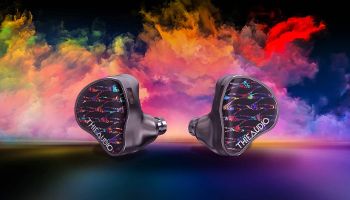

Thieaudio has been one of my favorite brands in the personal audio business for a number of years and though it’s common for brands to have ups and downs it has the unique distinction of delivering repeated wins, both critically and in impressions from real users.
With the Thieaudio Valhalla, the company officially has a new flagship coming in at a cool $1,999. It’s definitely within the purview of our Golden Ears column. Spoiler alert: this is an amazing set, just as you would expect for such a high cost of entry, but unless you have the deepest of pockets, it is a tall order that could also benefit from a few extra accessories to sweeten the pot. Join me as I take a deep look at this exciting new pair of in-ear monitors as we set out to discover just what you get for two grand in the IEM business.
Specifications
Current Price: $1,999 (Linsoul)
Driver Configuration
Low-End: (4x) Sonion 38D1XJ sub-woofers
Mids: (10x) Sonion E50DT dual drivers
Treble: (4x) Knowles RDE-33729
Upper-Treble: 1 Knowles WBFK-30095
Frequency Response: 10Hz-44kHz
Impedance: 9 Ohms
Sensitivity: 103dB
Crossover and Tubing: 4-Way passive, 4-bore acoustic tubing
Thieaudio Valhalla – Design and Highlights
The Thieaudio Valhalla is an impressive set in virtually every respect. It bucks many of the most in-vogue design trends to deliver something that is unique and uniquely handcrafted. In a world where many brands seem content to release a new must-have set every month or two (leading to multiple “must-have sets” each of those months), this is a set designed to last as a demonstration of Thieaudio’s acoustic expertise long into the future.
Rather than go with 3D printed resin shells like many other brands or even an aluminum alloy, the Valhalla goes a step further by using high-grade titanium for its shells. Each shell is precision milled using CNC machining. According to the company’s product page, the use of titanium makes these more durable and lightweight than typical materials, which, compared to steel, is true when it comes to weight. The strength of titanium is also well known, so there doesn’t seem to be much exaggeration here.
But let’s be real, the durability benefits of titanium, while true, aren’t likely to matter very much here. Instead, it strikes me that the use of such an exotic metal is directly related to the level of quality and luxury Thieaudio is going for here. It’s not likely anyone is going to be bending the Valhalla in a way where titanium is going to make a difference, but given their price, having such a strong material is reassuring in the event that they should get dropped.
The dark gray of the shells also contrasts beautifully with the polished gold foil faceplates. IEMs, at all price points, can sometimes tend into jewelry territory with their aesthetics. The Valhalla is absolutely beautiful without falling into this category, in my opinion. It looks amazing, but it doesn’t become ostentatious. It’s the kind of thing that if somebody stops and takes notice, they’ll find a lot to appreciate in the intricacies of its design, but it won’t garner attention purely because of glitter and shine or a brightly colored resin shell.
Internally, the Valhalla uses a massive 19 balanced armature array in each ear. You read that right—this pair of IEMs features a total of 38 tiny drivers. Talk about surround sound!
Well, not quite. And frankly, it’s not necessary to have so many drivers to achieve a given level of audio quality, an assertion that stands in contrast to the claims of smaller brands that lean on sheer driver count to drive sales. There are many amazing sets of IEMs that use a single driver or a much smaller selection or combination, but using this array does have objective benefits that pay dividends in the overall listening experience as Thieaudio has applied them here.
It’s akin to a chef versus a cook. Both are capable of delivering excellent meals, but the chef, a master at his craft, is better able to utilize every ingredient, whether that’s a single item dish or a complex dish with multiple ingredients to create a rich palette of flavors. It’s all about how those ingredients are used in the expertise and intentions of the person applying them.
As I mentioned in the lead-in, this set clearly appears to be a demonstration of Thieaudio’s abilities, and having listened to a wide range of their sets over the last five years or so, I can say confidently that this is one of the best pairs of IEMs they have ever produced. Those 19 drivers, while not individually audible, are well utilized and split into specializations that are tuned to deliver a precise sound profile that is at once revealing and incredibly clear while also sounding spacious and eminently engaging.
There’s a lot going on here, so let’s break it down. Those 19 drivers are split using four second-order crossovers, dividing the frequency response into lows, mids, highs, and ultra highs. Each register is driven by a selection of drivers chosen for their prowess at that particular frequency range. Dividing frequency duties in this way allows each individual driver to operate without being pushed to its limit. This reduces distortion and enhances clarity.
Diving into specifics though there are many different manufacturers of balanced armatures. Thieaudio has gone with premium and comparatively expensive Knowles and Sonion drivers. Bass duties are handled by four Sonion 38D1XJ007 subwoofers. Anyone who believes that balanced armatures can’t produce good bass clearly hasn’t heard the Valhalla. The midrange is covered by a whopping 10 additional drivers, Sonion E50DAs. Given the wide range of vocals and instruments this register represents, it makes sense that this would be the most bolstered range. Treble is handled by an additional four BAs, this time Knowles RDE 33729s. Finally, for the air frequencies and creating that wonderful sense of spaciousness and atmosphere, is a final Knowles WBFK 30095 tweeter.
Collectively, this driver array is able to produce sound from 10Hz to 44kHz. And because balanced armatures are relatively easy to drive, it’s able to deliver its sonic performance without demanding a powerful amplifier. In fact, these are quite easy to drive with an impedance of 9 ohms and a sensitivity of only 103 dB, though a set of this caliber deserves an equally high-quality source. I was able to plug it into my Razer Blade 16 gaming laptop and enjoy listenable volumes.
The acoustic delivery has more to it than simply throwing a selection of drivers together. The internal design of the set is also well considered and innovatively designed. It utilizes what, to my knowledge, is the first iteration of a new bass system from Thieaudio that it refers to as PBS (Precision Bass System). Within each shell is a small resonance chamber that feeds into a specialized cavity designed to enhance lows and ultra-lows so you can enjoy a sense of impact for instruments like kick drums or explosions in games.
Using its crossover network, Thieaudio has also been able to tune the remainder of the frequency range. While powerful bass is a stated goal, I think its more noteworthy achievement is how well it balances clarity with realism and space. Looking at its frequency response graph, as we’ll do in the final section of this review, we can see some very intentional choices like defined pinna gain for spaciousness and peaks and valleys designed to remove mud from the listening experience without impacting its enjoyability or unique character.
Keeping things simple, there’s a lot going on here, and I have to say, I appreciate that Thieaudio really doesn’t oversell it very much. The audio industry is notorious for selling snake oil, and like any brand hoping to make a sale, Thieaudio will always play up the performance of any set it sells. In this case, though, the Valhalla follows through on just about every aspect the company describes — with one exception, I’ll get right to when we move to listening impressions.
Rounding things out, however, we need to take a look at everything you get in the package. In addition to the IEMs themselves, you get a modular cable that includes terminations for 3.5mm single-ended sources as well as 4.4mm balanced sources. It’s Thieaudio’s highest-tier cable and is sold on its own as the EliteNoir for around $140.
In the luxury audio space, cables are an important consideration and are one of the most frequent things listeners will swap if they find it unmatched to the IEMs themselves or flawed in some way. This cable is made of silver-plated 5N oxygen-free copper and insulated with PVC shielding. In this case, the company makes big promises about how it will impact sound, but I’m not sold that differences would even be audible in this circumstance. Instead, what matters is that its 161 wires are relatively soft and easy to manage. The PVC shielding, on the other hand, does have a bit of memory. So, I found it necessary to straighten out the cable when removing it from the screw-top case that’s also included with the package.
Also included in the box is a small selection of silicone and memory foam ear tips and a cleaning cloth. This is one area where I do think the Valhalla falls woefully short. At this price, it really should include some extras, especially when companies like FiiO can include a wide range of tips at much lower prices. It’s especially noteworthy here because this is a larger set, so ensuring you find the proper fit is critical to your enjoyment.
Thieaudio Valhalla – Comfort
When it comes to comfort, the Thieaudio Valhalla is going to be hit or miss for many users. It’s a tale of pluses and minuses and highly dependent on your own personal tastes and preferences.
On the plus side, the company has done a stellar job of making the set lightweight and as small as they reasonably could without sacrificing their acoustic aims. A pair of large metal IEMs like this could very easily become heavy and feel like they want to fall out of your ears, but that’s just not the case here—at least with proper ear tips.
Fitting 19 drivers into each side while also making room for unique acoustic designs is no small feat. These IEMs are indeed large, and if you have smaller ears, even though they’re lightweight, you may find that they stick out a bit more than is preferable or alternatively that they press into your ears. Should they stick out more than intended, they are much more likely to be subject to gravity and need to be readjusted over time.
This is where offering some additional accessories would be very beneficial. I’m not a fan of memory foam ear tips, which are included and go a long way to mitigating the potential for this issue. However, if you are a fan of silicone, you’ll need to ensure you have the right size for each ear, and it’s not a given that those are going to be the same.
For me, none of the included tips felt secure enough for long-term listening where I could forget they were there and just enjoy their performance. I swapped to a pair of AZLA XELASTEC II eartips, which are made of a heat-sensitive polymer and mold to your ear canals with your body heat. With these, the Valhalla was perfectly secure and, thanks to the natural custom molding that takes place, were very comfortable and isolating.
Thieaudio Valhalla – Listening Impressions
Graph Credits: Bad Guy Good Audio Reviews via Squig Link (BGGAR YouTube)
With all of that out of the way, we come to the most important question: How do they sound? Across its product page, Thieaudio never claims that these are perfectly flat or reference, though it does include language about maintaining neutrality in the face of other tuning decisions, like its bass shelf.
My experience largely matches the frequency response graph included above and provided by the manufacturer. This is, overall, a U-shaped pair of IEMs. What that means is that there’s noticeable enhancement to both the low and middle-high to high frequencies that captures the broad strokes of its sound signature but hardly tells the whole story. The technical prowess and execution of this signature is really what sets the Valhalla apart and why it sits atop the brand’s current mountain of available IEMs.
Bass: Leading up to this review, there was conjecture about whether the Valhalla was intended to replace Thieaudio’s previous flagship, the V16 Divinity. I have a review of that set coming up in the near future, but it’s actually the bass that acts as the biggest sound character differentiator between the two and why I believe the Valhalla is not a direct replacement for this set and shouldn’t be viewed as one for musicians that may be looking for a new set of stage monitors.
The bass here is very well done. It has an emphasis to it, but also excellent speed, which makes for great textural details. This translates very well for synths and bass guitars, or in the world of gaming, cinematic soundtracks, and sound effects with deep low frequency layers. There is a punchiness that’s especially audible with kick drums (or gunshots and explosions). At the same time, it sounds slightly restrained and isn’t overpowering while the bass reaches low and offers rumble. The V16 is significantly more powerful in this department.
Still, I hardly consider that a knock against the Valhalla. It’s just a different tonal character. It maintains the U-shaped signature that makes music and other forms of audio entertainment engaging and fun without negatively impacting frequencies higher in the audible range.
Mids: To my ear, the mids are the highlight of this set. It’s where so many of its strengths become clearly audible. The separation between sound sources like instruments in a band or the layers of sound when traveling through a dense region in an MMORPG is immediately noticeable, and you don’t have to be an audiophile to take note. The Valhalla holds a magnifying glass up to the individual ingredients of its soundscapes.
All that flowery language aside, to my ear, what that amounts to is a very revealing listening experience. Because not only can you hear each of those individual elements, they’re presented with a crispness and realistic clarity that’s akin to jumping from 480p to 4K. Remember, most instruments in contemporary and classical music, percussion aside, have their fundamental frequencies within this range. It’s here where they define their timbre and individual character—qualities that are enhanced by the performance of frequencies in the treble and air regions.
It’s also where vocals live, and whether you’re listening to a man or woman, the Valhalla renders them faithfully, if a touch warmly. Interestingly, between instruments, sound effects, and vocals, I don’t recall the set ever sounding sharp. That careful tuning I alluded to before softens edges that might otherwise be fatiguing but, particularly impressively, it does sound without also sounding dulled. It’s impeccably balanced in its presentation.
Highs: Further examples of this presentational balance are found in the highs and ultra-highs. These regions help to provide lower frequency sources like trumpets, guitars, and synths with their sense of extension in the full range of their character. An electric guitar, which mainly generates frequencies smack dab in the mids, sounds underwater without its higher harmonics resonating in the treble. Even if you don’t consider yourself a fan of treble (most mainstream listeners would instead opt for powerful bass), balance in this area is absolutely critical for an enjoyable listening experience across genres and content types.
This is the case for both the naturalness of how things sound, but also how enjoyable the set is to listen to in general. Tweak the highs too much or have peaks in the wrong places, and anything musical or detailed you’re listening to can quickly turn sharp, sibilant, and fatiguing. The Sonion balanced armatures get the job done as tuned by the engineers at Thieaudio.
The highs are detailed, spacious, and well-defined, really raising the resolution of the set in general. But, as I mentioned in the prior section, they are particularly smooth, shaving off those edges that might cause you to take a break before you’re really ready to. It does this with panache, however, making it harder to perceive that something was lost, but rather creating the impression of deliberate presentation and refinement.
Soundstage and Imaging: Soundstage and imaging are an absolute highlight of the Valhalla. The soundstage is spacious, as wide as it is deep, and has a very directional presentation. I especially enjoyed listening to Sleep Token’s latest album, as its atmospheric elements seem to wrap around you. The expert engineering of this album, as well as Take Me Back to Eden, also plays very nicely with the directional introduction of instruments and vocals. Soundstage and imaging are both stellar with this set.
Compared to the Thieaudio Monarch MK III and Prestige LTD: I’ve already discussed the V16 Divinity and some of the differences I see, but how does it compare to the Monarch MK III and Prestige LTD, two other of Thieaudio’s premium high-performance sets?
I found this especially interesting because I frankly love both of those other sets. It’s difficult for me to say that any one is better than the other, except that in this case, the Valhalla is definitely better than the Monarch or Prestige… at least for certain listeners. At this quality tier, “best” becomes a very subjective term.
While all three are very impressive in the realm of detail retrieval, the Valhalla does an even better job with separation and layering. None of these sets are lacking in this department, but because the Valhalla does enhance this quality, the perceived detail is better.
When it comes to bass, the Monarch MKIII takes the lead with the Prestige LTD right behind it. At the same time, the Valhalla is more balanced overall, offering enjoyable bass with a more self-contained presentation.
The Valhalla returns to the top spot for me in treble because of its smoothness. It really is impeccably tuned in this department, balancing clarity with listenability, even if you wanted to keep them in your ears for a whole workday.
To be completely frank, however, each of these sets delivers a different flavor. They are all fantastic in their own right, but present each register slightly differently. If you are truly stuck between these three sets, my biggest suggestion would be to try them in person if at all possible, even if that means buying from a seller with a generous return and exchange policy. If you can’t do that, listening tests on YouTube are a good second choice.
How are they for gaming? Absolutely positively killer. While I would never suggest someone spend this much money purely for gaming, the way they deliver sound is so well-suited to getting immersed in a game or even competing against others that it feels like someone on the team must have worked this into the tone map. The thing is, I don’t actually think this is the case. I think that Thieaudio designed the sound signature for audio enthusiasts, and in doing so pulled off detail, listenability, and impactful but balanced low end that it stumbled across one of the best tunings I’ve heard for gaming in high-end audio. It’s spacious, detailed, well-layered, fun, rich, and a whole lot of other adjectives besides that make it a fantastic pick for gaming.
Final Thoughts
Throughout this review, I haven’t obscured the fact that I believe this is Thieaudio’s crowning set. It offers such an impeccable balance of acoustics that it’s a joy to listen to. I only wish more people were able to hear it and discover that as well, but given that every single pair is hand-polished and made to order, its high price isn’t going anywhere soon. The Thieaudio Valhalla an achievement in high-end audio, however, and I highly encourage anyone with a chance to give it a listen to jump on the opportunity.
The product described in this article was provided by the manufacturer for evaluation purposes.