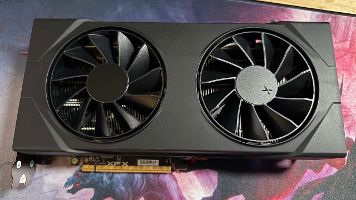

AMD is taking aim at the entry-level GPU market with its latest offering, the Radeon RX 9060 XT. Positioned to square up nicely against rival Nividia’s RTX 5060 Ti line-up of GPUs, the RX 9060 XT is meant to be a 1440p performer at high framerates, whether playing traditionally rasterized games or using ray tracing. We put the new GPU through its paces to see how it stacks up and whether it’s worth the asking price.
Specs:
Process Node: TSMC N4P
Compute Units: 32
Ray Accelerators (3rd Generation): 32
AI Accelerators (2nd Generation): 64
Stream Processors: 2048
Game GPU Clock: 2530 MHz
Boost GPU Clock: up to 3130 MHz
Memory: 16GB GDDR6 (Reviewed)
Also available in 8GB GDDR6 version
Memory Speed: 20Gbps
Memory Bus Width: 128-bit
I/O:
2 x DisplayPort 2.1a
1 x HDMI 2.1b
Total Board Power: 160W
Recommended PSU: 250W
MSRP: $349 (16GB); $299 (8GB)
First Thoughts
The AMD Radeon RX 9060 XT doesn’t come in a Reference model, so we’re reviewing the XFX Swift RX 9060 XT 16GB model, much like we did with the RX 9070 XT and RX 9070 earlier this year. Our MSRP version is listed at $349, though like all things GPU this time around, finding one at that price might prove tricky, so it’s worth bearing in mind. We’re looking at the 16GB version that AMD sent us today, but the company is also shipping an 8GB variant which lists at $299 MSRP, though we really don’t recommend any card with 8GB nowadays, as 8GB has proveably shown it’s not enough for modern gaming tasks, especially with features like ray tracing turned on.
This is crucial as more and more games are starting to require RT-enabled GPUs from the jump. Indiana Jones and the Great Circle is one, while the recently released Doom: The Dark Ages is another, and it’s only going to continue. An 8GB card is likely hamstrung from the get go as a result, so our recommendation is to simply look at the 16GB option from the jump if you’re keen on getting a new entry-level card.
But I digress. Aesthetically, the XFX Swift RX 9060 XT isn’t really anything to call home about. It’s your standard gaming aesthetic with a black shroud (though it is also available in white), a two-fan, two-slot design, and comes with a single 8-pin PCIe connector, so 12VHPWR cables need not apply.
Interestingly, the RX 9060 XT ships with just three display connectors: two DisplayPort 2.1a ports and a single HDMI 2.1b port. This likely isn’t a huge deal for those who are buying this card as I can’t image a $349 GPU slotting into a mega powerful battlestation with four or more monitors, but it’s definitely intriguing to see and it makes me wonder if future entry-level GPUs will cut down on I/O to potentially help bring the cost down.
Built atop the RDNA 4 architecture, the RX 9060 XT takes advantage of AMD’s latest advances in graphics technologies, especially in the form of the latest generation of its upscaling technique, FidelityFX Super Resolution (FSR). FSR 4 is the first in AMD’s line up to use AI machine learning to upscale the image with cleaner, more accurate results versus FSR 3. We talk a fair bit about this in our RX 9070 XT review, which you can read here. Suffice to say, though, we thought FSR 4 was a clear leap in quality over its predecessor and truly believe every FSR-enabled game should strive to implement it as soon as humanly possible.
AMD Radeon RX 9060 XT Performance Benchmarks
So how does it all stack up? A few things to note: we only have the 16GB variants of both the RX 9060 XT and the RTX 5060 Ti to test as we were not sent an 8GB unit of either from AMD or Nvidia. Additionally, we do not have the RTX 5060 to test alongside these GPUs as well, so those numbers will be absent from our bench. This is a perfect opportunity to mention that plenty of outlets will have those numbers, so when you’re finished reading our review, please make sure to read and watch other reviews before pulling the trigger on a new card so you can get as much actionable data as you can.
Additionally, like our RTX 5060 Ti review, we opted to focus squarely on 1440p, as this is the target resolution for the RX 9060 XT. Again, another reason to read other reviews to get more data points to consider.
We’re using our Starforge Systems Voyager II test bench as we have all year for our GPU reviews. We detailed why in a separate post, but here are the specs for a quick glance.
CPU: Intel Core i7-14700K
CPU Cooler: Starforge Custom Bitspower 360mm Liquid Cooler
RAM: Teamgroup Delta RGB 32GB DRR5 6000 CL38 (2x16GB)
Motherboard: MSI Z790 Tomahawk Wifi DDR5
Cables: CableMod Pro ModMesh Sleeved Cable Extensions (Black)
Primary Storage: 2TB PCIe 4.0 NVMe SSD (min 7000 read)
Power Supply: Corsair HX1200i 1200 Watt Platinum
RGB Fans: 6 x Bitspower 120mm ARGB
Case: Lian Li O11D EVO RGB Mid-Tower (SMITE Custom Printing Version)
Being a 1440p-focused card, we put the RTX 5060 Ti up against other similarly-targeted cards across Nvidia and AMD’s line up of GPUs.
Nvidia:
ASUS Prime RTX 5070 Ti
PNY RTX 5060 TI 16GB OC
RTX 5070 Founders Edition
RTX 4070 Super Founders Edition
RTX 4060 Ti 8GB Founders Edition
AMD
XFX SWIFT RX 9070 XT
XFX SWIFT RX 9070
As with all our recent reviews, we’re testing the GPU as people are going to actually use them. This means that our testing will include features such as FSR and Nvidia’s Deep Learning Super Sampling (DLSS) enabled when possible. Additionally, when available, we’ll utilize frame generation features to show the type of performance you might expect when utilizing those features.
When possible we utilized in-game benchmarking tools in order to get the most consistent, accurate result with each benchmarking run. When we coulding, we used a predefined circuit within each game that was repeatable to try to create as consistent a result each time, such as the opening moments of Spider-Man 2 swinging through the streets of New York City, or capturing data from the exact same section of a replay in Marvel Rivals. As always, ReSizeable BAR and XMP Profiles were enabled on the PC via the system BIOS.
XFX SWIFT RX 9060 XT 16GB Synthetic Benchmarks
While synthetic tests don’t tell the whole story, they can point to some of the trends we’re going to see in gaming benchmarks. In Firestrike, our RX 9060 XT performs just 1.7% slower than the RTX 5060 Ti 16GB, well within the margin of error, while the more powerful RX 9070 XT and RX 9070 outstrip the new GPU by 44% and 38%, respectively.
In Timespy we see much the same, though this time the RX 9060 XT takes slight lead over the RTX 5060 Ti, though again, it’s well within the margin of error. Port Royal shows a loss across the board compared to the cards in our bench, with the RX 9060 XT 5% slower overall in the 3DMark ray tracing test compared to the RTX 5060 Ti. Compared to the last generation RTX 4060 Ti, the RDNA 4 card does come out on top with a 21% lead, however.
XFX SWIFT RX 9060 XT 16GB Gaming Benchmarks
So how does it stack up in gaming? Looking at the XFX SWIFT RX 9060 XT, when compared directly with the RTX 5060 Ti, the nearest priced competitor of the RX 9060 XT, we see Nvidia take a 4% lead in performance on average overall in our testing. In Cyberpunk 2077, we see the RTX 5060 Ti 16GB take a 7% lead over the RX 9060 XT at 1440p, while it lags 30% slower than its more powerful RDNA sibling, the RX 9070.
In Forza Horizon 5, see the lone win for the RX 9060 XT, a full 8% faster than the RTX 5060 Ti at 1440p, 126fps versus 116fps on average, respectively. In Black Myth Wukong, a game that seemed to hamper AMD cards in the past, we see the RX 9060 XT eke out a respectable 46fps average when using TSR and the full Cinematic mode without frame generation, although the game still seems to favor Nvidia’s GPU with AMD 16% slower than the RTX 5060 Ti.
XFX SWIFT RX 9060 XT Ray Tracing Benchmarks
In ray tracing applications, we see the RDNA 4 card perform quite well, though still lag behind Nvidia’s GPUs. Compared to the RTX 5060 Ti, the RX 9060 XT performed 36% slower on average across the board (and this is without Nvidia’s multiframe generation taken into account). Even last generations RTX 4060 Ti outperforms the RX 9060 XT here, such as a 33% increase in performance in Cyberpunk 2077 over the RDNA 4 card (both cards using 2x frame generation), while Returnal sees the RTX 4060 Ti lead the RX 9060 XT by 24%.
XFX SWIFT RX 9060 XT FSR 4 Tests
RDNA 4’s big feature for gamers is FSR 4, Team Red’s new AI upscaling solution. While Nvidia has a multi-year headstart on machine learning image reconstruction in games, FSR 4 has shown some incredible looking results out the gate, and does some heavy lifting when it comes to ray tracing applications being playable at good framerates.
Marvel Rivals was the only game in our test that actually got worse from native 4K when enabling FSR 4, dropping down to 53fps on average from Epic’s TSR’s 61fps – but the image quality more than made up for this with FSR 4 looking so, so much cleaner as a result. Flip on frame generation and the hero shooter got even more playable at 85fps without much hit to latency.
Spider-Man 2’s heavy implementation of ray tracing meant that even with frame generation we were only able to eke out a 35fps average at 4K. However, when dropping the resolution down to 1440p, which is where most players getting a 9060 XT will be at anyways, that FSR 4 FG result turns into 90fps average in our testing, though its 1% lows still leave something to be desired, sitting around 44fps.
Monster Hunter Wilds might be the best looking implementation of FSR 4 on the market right now, and at 4K it looked pixel perfect while sitting a normal distance away from my Acer 43” 4K display I used for this part of the testing. Because AMD is finally using machine learning for this technique, these images and results will only get better as the model learns over time, something we saw with DLSS in its early days (though I daresay, FSR 4 feels a generation ahead than the earliest versions of DLSS).
XFX SWIFT RX 9060 XT Final Thoughts
So what do we make of all this? The RX 9060 XT is, at its core, a decent 1440p performer. While coming in cheaper than the RTX 5060 Ti 16GB version (at least on paper), the card manages to stay within about 4% of the performance of the Nvidia GPU, which costs 22% more money.
16GB proves to be a good sweet spot for VRAM this generation, and throughout my testing I didn’t notice any stutters or issues with games running up against the 16GB buffer provided on the card. Again, without the 8GB variant to test, I can’t be sure how that one will fare, but future proofing would dictate buying the slightly more expensive GPU with more VRAM to utilize in the years to come.
And this is all assuming you can find the card at retail price.
This is where recommending even the 16GB version of the RX 9060 XT proves somewhat difficult. Sure, it’s not a bad card for 1440p gamers, and PC gamers who are looking to upgrade from older 5000 or 6000-series AMD GPUs will find a good upgrade path here. But given that GPUs at retail price are pretty much nonexistent across every GPU launch this year (even now you cannot find the other RDNA 4 cards at retail price months after their release), I don’t have much faith in the supply chain to make this any different.
Who knows, maybe this is the time AMD and their board partners are able to keep MSRP GPUs on shelves at that price long enough for players to nab them up. But if you’re ending up spending a hundred, or even two hundred dollars over retail price for a GPU, you’re better off buying a console like the PlayStation 5 or the Xbox Series X (even with the latter’s recent price increase).
However, if PC is your only option, the RX 9060 XT is the one in the price range I’d recommend. Sure, it lags behind ray tracing performance compared to its Nvidia competition, but that GPU is $80 more (again, on paper), but it’s closed the gap enough thanks to frame generation and FSR 4 that it feels moot at this point (unless you’re really keen on that multi-frame generation, which fair, I am too).
Full disclosure: This product was provided by the manufacturer for the purposes of this review.