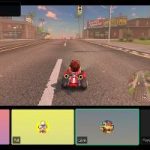

When looking over the Nintendo Switch 2’s launch library for a technical powerhouse title to put the system through its paces, Split Fiction possibly isn’t the first game many people are going to jump to download. Cyberpunk 2077 pushes city details and crowd density that made the PS4 strain, Street Fighter 6 pushes impressive graphics at a competitively necessary 60 FPS, and Mario Kart World mixes high framerates with eye-catching squash and stretch animations.
Split Fiction, however, pushes the Switch 2 hard in other ways, less immediately obvious at first glance. As a showcase for splitscreen multiplayer, fast loading times, and visual design variety, there’s perhaps no better game in the system’s launch library to give a well-rounded view of the ways the system stands head and shoulders above the OG Nintendo Hybrid.
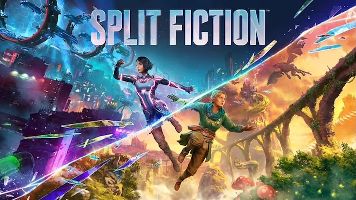
For those who haven’t played it, Split Fiction is a third person co-op platforming action title where you and a friend play either Mio or Zoe, a pair of authors sucked into a virtual world by a tech billionaire trying to directly train AI on the creativity of unpublished writers.
The game obviously has to generate two different viewpoints of its world, rendering both Mio and Zoe’s perspectives separately during gameplay. Splitscreen gameplay isn’t anything new; there were games on the original Switch that pulled this off well enough, but Split Fiction really pushes the limits of how different each player’s perspective in a co-op game might be, with extended sequences where players are completely separated from each other and doing various unrelated tasks.
At its core, Split Fiction on Switch 2 handles this dual perspective setup well, holding a solid 30 FPS throughout my initial testing. Sure, that’s not the 60 FPS you’ll get playing the game on other home consoles, Xbox Series S included, but it keeps that 30FPS locked solidly. For a game like this one, the drop to 30 FPS isn’t a huge deal. Split Fiction is never a game about twitch reaction speeds, and I’d far rather a solid locked 30 FPS than an inconsistent attempt at reaching higher.
There are some basic visual cutbacks too; it’s not as high resolution as it’ll look on your PS5, but the drawbacks and concessions feel pretty minimal in the grand scheme of things. This is hardly the port of the Witcher 3 to the original Switch, we’re not seeing such huge cutbacks to visuals that the tradeoff for portable play has to be heavily weighed. The costs of getting Split Fiction running on a handheld are minimal, I don’t think anyone who plays the game for the first time on Switch 2 is going to feel like they’re playing an obviously inferior version of the game, the way they might have done with some of the OG Switch’s more ambitious port projects.
Beyond the obvious split perspectives, the other place where Split Fiction shines on Switch 2 is its speedy loading times. There are numerous points in Split Fiction where the protagonists jump to wildly different genres of location with completely different art assets, and I never felt like I was waiting around for the game to load in the background. This is the title from the system’s launch lineup that most made me confident that the system’s built-in memory, or Micro SD Express card read speeds, are close enough to modern SSD drive speeds as to feel like comparing their performance is fair. The Switch 2 port of Split Fiction even kept pace in areas deliberately designed to throw assets at the player at high speed, making me confident in recommending the port to others.
Lastly, Split Fiction has multiple ways for two people to play a single copy of the game on Switch 2. You can obviously play local split screen on one Switch 2, or download a friend pass to play online multiplayer without buying a second copy of the game. However, most interestingly, you can also play this Switch 2 game on your Switch 1.
Gameshare is a Switch 2 feature supported by certain games where gameplay can be streamed to another Switch, allowing for multiplayer gameplay without additional devices needing to download the game. If you’ve both got a Switch 2, this can happen over the internet, but if you’re two local players, you can use a Switch 1 as a receiver, and get Split Fiction’s gameplay broadcast to your device, sending your inputs back to the Switch 2.
This setup, playing as a second player via a local connection on a Switch 1 that didn’t have the game downloaded, really impressed me. It wasn’t quite as visually clear as playing locally on Switch 2, but it was clear enough to understand, and gameplay performance was pretty responsive. I could easily have played as a second player in this manner, something not really possible on other platforms. This feature is really neat, and something I hope we see more Switch 2 games support.
Split Fiction on Switch 2 definitely features a few little compromises visually compared to stronger console ports, but those compromises feel pretty small in the scale of what the game achieves. This isn’t the Switch 1, where impossible ports were “good for a handheld”; this is a port that looks legitimately decent on a modern TV, and runs off essentially a tablet. The experience is so much closer to its current generation contemporaries than I expected, a great sign for a day one port to the system.